
Guidelines for the Frontline
Talk It Out.
Tips for how to use Conversational AI
Tips for how to use Conversational AI
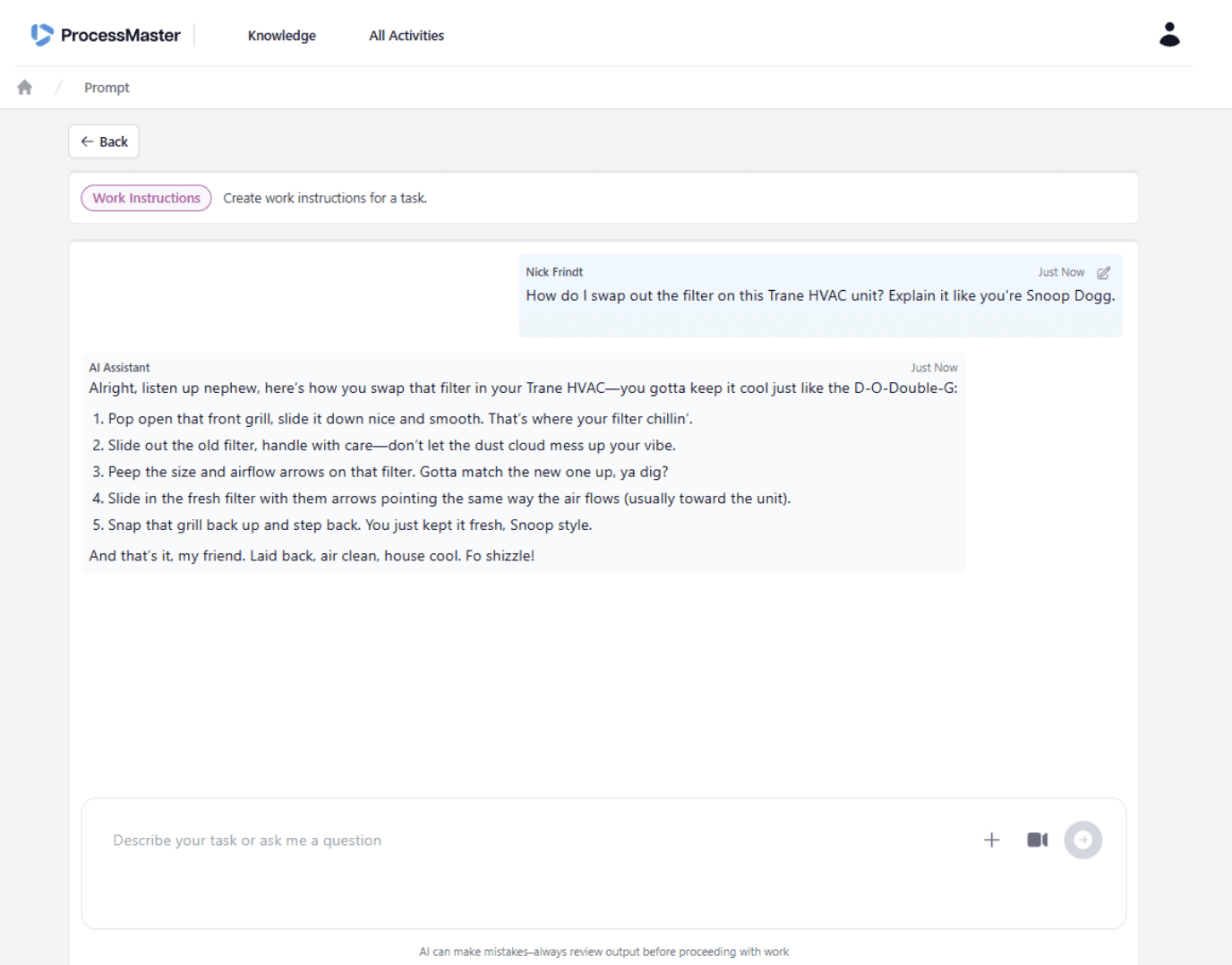
Talk to it like a person, not a Google search.
Use full thoughts, imperfect grammar, and natural language like you would explain something to a coworker. Typos and polish do not matter. Being clear does.
Talk to it like a person, not a Google search.
Use full thoughts, imperfect grammar, and natural language like you would explain something to a coworker. Typos and polish do not matter. Being clear does.
Talk to it like a person, not a Google search.
Use full thoughts, imperfect grammar, and natural language like you would explain something to a coworker. Typos and polish do not matter. Being clear does.
Treat it like the best assistant ever, who was just hired this morning.
AI can help you move faster, but it does not know your job until you teach it. Share where you are, what you are doing, who this is for, and what “done” looks like.
Treat it like the best assistant ever, who was just hired this morning.
AI can help you move faster, but it does not know your job until you teach it. Share where you are, what you are doing, who this is for, and what “done” looks like.
Treat it like the best assistant ever, who was just hired this morning.
AI can help you move faster, but it does not know your job until you teach it. Share where you are, what you are doing, who this is for, and what “done” looks like.
Provide visual context.
A photo of the machine, a short video of the task, or an existing document gives AI instant context that words alone cannot. When in doubt, attach it.
Provide visual context.
A photo of the machine, a short video of the task, or an existing document gives AI instant context that words alone cannot. When in doubt, attach it.
Provide visual context.
A photo of the machine, a short video of the task, or an existing document gives AI instant context that words alone cannot. When in doubt, attach it.
Be aggressive in your requests.
Do not hint or hope. Be specific about format, length, tone, and other expectations. If the answer is not perfect, give it notes for improvement.
Be aggressive in your requests.
Do not hint or hope. Be specific about format, length, tone, and other expectations. If the answer is not perfect, give it notes for improvement.
Be aggressive in your requests.
Do not hint or hope. Be specific about format, length, tone, and other expectations. If the answer is not perfect, give it notes for improvement.
Give it options.
AI struggles from information overload, just like we do. Open-ended questions can lead to inaccurate answers. Providing it options to choose from keeps it focused and grounded in reality.
Give it options.
AI struggles from information overload, just like we do. Open-ended questions can lead to inaccurate answers. Providing it options to choose from keeps it focused and grounded in reality.
Give it options.
AI struggles from information overload, just like we do. Open-ended questions can lead to inaccurate answers. Providing it options to choose from keeps it focused and grounded in reality.
Ask why.
Ask AI to provide its reasoning for recommendations or explain its answers. This helps to ensure you’re receiving the most accurate and up to date information, always. .
Ask why.
Ask AI to provide its reasoning for recommendations or explain its answers. This helps to ensure you’re receiving the most accurate and up to date information, always. .
Ask why.
Ask AI to provide its reasoning for recommendations or explain its answers. This helps to ensure you’re receiving the most accurate and up to date information, always. .
Bonus Tip
Try to break it.
To see just how limitless Conversational AI is, stretch your imagination and try to trip it up.
Quick Starter Prompts
“I’m doing [task] at [site or area]. Provide work instructions, and keep in mind that it is snowing today.”
“Create an SOP for [task] that I can print and post.”
“Rewrite this in Spanish. English is my second language.”
“Ask me 3 questions to fill in missing details before you create the work instructions.”
“Should I use a ladder, or does this require scaffolding? Give me the pros and cons of each.”
“Make this shorter. Then make it even shorter. We need simplicity.”
“I’m doing [task] at [site or area]. Provide work instructions, and keep in mind that it is snowing today.”
“Create an SOP for [task] that I can print and post.”
“Rewrite this in Spanish. English is my second language.”
“Ask me 3 questions to fill in missing details before you create the work instructions.”
“Should I use a ladder, or does this require scaffolding? Give me the pros and cons of each.”
“Make this shorter. Then make it even shorter. We need simplicity.”
“I’m doing [task] at [site or area]. Provide work instructions, and keep in mind that it is snowing today.”
“Create an SOP for [task] that I can print and post.”
“Rewrite this in Spanish. English is my second language.”
“Ask me 3 questions to fill in missing details before you create the work instructions.”
“Should I use a ladder, or does this require scaffolding? Give me the pros and cons of each.”
“Make this shorter. Then make it even shorter. We need simplicity.”
Give your team their time back
Learn how Automation is helping crews create AI Work Instructions and optimize productivity. Discover which of your processes - paper or digital - can be thrown away.
Give your team their time back
Learn how Automation is helping crews create AI Work Instructions and optimize productivity. Discover which of your processes - paper or digital - can be thrown away.